One of the most important and most explosive sources of conflict in our time is the centuries-old confrontation, flaring up again today, between the Islamic world and Western culture, which grew from the roots of Christianity and ancient philosophy. Two worldviews stand facing each other here, and they differ sharply in some of their most basic convictions. How each of them weighs the individual against the family, and the state against religion, are just two of the areas that the public is especially aware of.
Through the immigration of people from Islamic countries over the past decades, a situation has arisen that is entirely new in history: there are now large Islamic minorities in the countries of Europe. The question of how Christians and Muslims, and also believers and non-believers, are to live together has therefore become more pressing than ever before. Understandably, this situation makes many people afraid. On the one hand it leads to a sweeping and therefore unjust rejection of Islam and its followers; on the other, to the real problems being pushed aside and denied.
In this situation I would like to take a look at how St Francis of Assisi dealt with this conflict, which in his day was fought out with particular violence through the crusading movement. Despite the differences between the situation then and now, I believe that Francis’s conduct can also give us impulses for how to act today. In what follows I draw on the writings of St Francis and on the biography by Thomas of Celano, who wrote the first medieval life of Francis, as well as on the book “Feuerwandler” by Jan Hoeberichts.
- The historical situation in Francis’s time; the theology of the crusades
- Francis’s attitude
- Summary and assessment
- The social situation in Germany
- Franciscan impulses for meeting Muslims
- Closing thoughts
1. The historical situation in Francis’s time; the theology of the crusades
Francis’s life, his conversion and the birth of his community all took place at a time when Europe’s confrontation with Islam was reaching a climax. Three crusades were waged during his lifetime: from 1189 to 1192, from 1202 to 1204 and from 1217 to 1221. The last of these, the Fifth Crusade overall, is especially important for understanding Francis’s fundamental concerns, because it was in connection with this crusade that he himself travelled to the Holy Land. Chapter 16 of the Earlier Rule (Regula non bullata), which deals with how the brothers are to behave towards the Saracens, was written under the impression of this journey.
Pope Innocent III prepared the Fifth Crusade carefully and energetically. He sent a circular letter to the whole of Christendom and appointed preachers to call people to take part in the crusade. Its basic ideas were these: since the Saracens were unlawfully occupying the land that is the “inheritance of Christ”, they had to be driven out by force of arms. Loyalty to Christ, the supreme King and liege lord, demanded this fight; anyone who held back persisted in “sinful ingratitude and wicked disloyalty”, for which the King of Kings would condemn him. At the same time the crusade offered a sure and simple way of gaining eternal salvation: by fighting the Saracens. The Saracens themselves were portrayed as murderers and wild beasts, as followers of the devil who had to be destroyed.
The idea of mission, of proclaiming the Gospel by the word, is entirely absent in Innocent III, though it can be found in some theologians and bishops, for example Jacques de Vitry and Peter the Venerable. For them, preaching meant exposing the errors and lies of Islam as clearly as possible, so as to lead the Muslims away from the teaching of the devil to the truth of the teaching of Jesus Christ.
Here and there, people asked whether killing the Saracens could really be justified in the light of Jesus’ teaching. Interestingly, these questions came from people who were taking part in the crusades in the Holy Land and so were in direct contact with the Saracens. The questions were sharply criticised, and those who raised them were accused of ingratitude. As for the commandment of non-violence, the Church held that it did not refer to practical action but to an inner attitude of the heart. In other words, killing as many Saracens as possible was an expression of gratitude towards Christ; but while doing so one should have an attitude of love and goodwill in one’s heart (this, for example, was the gist of a sermon that Jacques de Vitry preached to members of an order of knights).
Without being able to go into it in detail, it must of course be mentioned that the image of the Saracens prevailing in medieval Europe was badly distorted. At the beginning of the 13th century Islam was still in its golden age and in many respects culturally superior to the Europeans. It is no coincidence that it was the Christians living in the Holy Land, with their first-hand experience of Muslims, who raised critical questions about the purpose of the crusades and the demonisation of Islam. The Islamic sources of the period, for their part, speak of genuine astonishment at the crudeness and strength of the crusaders, and of horror at their brutal way of waging war. When the educated and cosmopolitan Emperor Frederick II obtained the handing over of Jerusalem to the Christians through a negotiated peace in 1229, Pope Gregory IX and many crusaders regarded it as betrayal, since the promise of eternal salvation for the crusaders presupposed armed combat.
To judge fairly this interpretation of the Gospel, which seems incomprehensible to us today, we have to see it in its historical context. Even in the Roman Empire it had been customary to use religion to stabilise the state, and to use force in doing so. The persecution of the first Christian communities makes this very clear. Islam, too, spread by military means, and Muhammad himself had begun to spread his religion by war. It is true that in North Africa and Spain the Islamic armies did not come up against intact Christian states, but conquered territories that had been shattered and destabilised by the migrations of the peoples. Even so, Christian Europe was left with the feeling of being threatened by the spread of Islam. To that extent the use of force was felt to be something natural, and was seen as a form of necessary self-defence.
This attitude was reinforced by the fact that the conversion of the Germanic tribes lay only a relatively short time in the past. Germanic values such as warlike heroism and absolute loyalty to the leader, unto death, still played a large part in people’s imagination and were transferred to Christ, the supreme King. St Bernard of Clairvaux, for example, played an important part in the attempt to inculturate the ethics of medieval knighthood into Christianity. The dark side of this process, necessary and good in itself, was his fervent advocacy of the crusades.
2. Francis’s attitude
His response to the crusade preaching
When you consider how comprehensive and elaborate the crusade ideology was, and how constantly present in public life (in every Mass, for example, prayers had to be said for the success of the crusade), it is astonishing how little of it is echoed in Francis. Nowhere does he comment directly on the crusades; there is not one disparaging, or even judging, word about the Muslims, although his journey to the Holy Land and his encounters there with crusaders and Muslims were one of the formative experiences of his life. While he joyfully took up the teaching on the Eucharist formulated at the Fourth Lateran Council in 1215 and stresses it repeatedly in his writings, he did not respond at all to the call to crusade issued by the same council, even though indifference towards the crusade was expressly called sinful ingratitude towards Christ. This is all the more surprising because the call to crusade uses terms that were also of great importance to Francis.
Pope Innocent speaks of “taking up the cross and following Jesus Christ”; he speaks of the “inheritance of Christ” having to be freed from the unbelievers. Both expressions also appear at central points in Francis, but with an entirely different meaning. When he speaks of the “inheritance of Christ”, he means the alms that are due to the poor, the necessities of life. Since Christ himself was poor, it is the duty of those who own things to share with the poor, and so to give Christ back his inheritance. The Earlier Rule says: “Alms are the inheritance and the just due of the poor, which our Lord Jesus Christ has acquired for us.”
When Francis says that we should “take up the cross”, he means the very opposite of a call to violence. We are to follow Jesus precisely in his humility and abasement, and in serving the weakest and practising non-violence and peaceableness we are to bear even the most extreme consequences. It is precisely for the proclamation of peace that Francis claims a direct divine inspiration, something he very rarely does so explicitly. “The Lord revealed to me that we should say as a greeting: May the Lord give you peace,” he writes in his Testament.
While the call to crusade held out the prospect of salvation for serving Christ with the sword and by killing, for Francis salvation lies in serving Christ as he meets us in the poor and the outcast. A greater difference in meaning between identical words than in the examples above is indeed hardly imaginable.
The journey to the Holy Land
For Francis it went without saying that he would put this basic attitude into practice in his own life. In 1219, accompanied by one of his brothers, he sailed to Palestine on a crusaders’ ship and stayed there for almost a year. Thomas of Celano reports two important incidents that shed a clear light on Francis’s attitude.
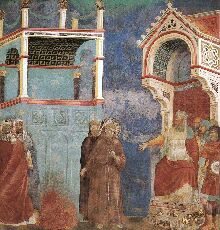
First there is the famous visit to the Sultan (the picture above shows the scene as Giotto painted it). Although the crusaders declare him mad and predict his immediate death, Francis goes to the Saracens in the middle of the fighting, unarmed and alone. Against all predictions, nothing happens to him. He has himself taken to the Sultan and talks with him. The Sultan proves to be an educated and cultivated man, who gives Francis an offer of peace to take back to the crusaders. This is Sultan al-Kamil, the same man who years later negotiated the peaceful handing over of Jerusalem to Frederick II. Sadly, we know nothing about what exactly was said. There is no statement from Francis himself, and the various accounts in the medieval biographies of a provocative, aggressively missionary appearance fit neither the personality of St Francis nor the evidently peaceful and hospitable mood of the visit, which an Arabic source also reports. Since there were in fact no Christian witnesses to the conversation, we can assume with good reason that the strong influence of crusade theology has left its mark on the biographers’ accounts here.
Another passage describes how Francis tries in a great speech to hold the crusaders back from battle and foretells their defeat. Before the speech he already senses that the knights will reject it, and he takes counsel with his brothers: “If I say it, they will take me for a fool; if I keep silent, I shall not escape my conscience. What do you think?” The brothers advise him to follow his conscience rather than political prudence. Francis gives the speech and is roundly laughed at (2 Celano 30). And indeed the crusader army then suffered a crushing defeat and had to withdraw. The opportunity that Francis had opened up with his strategy of non-violence was not taken. In this story, too, the biographer Thomas of Celano failed to grasp what the saint was really aiming at: he does not go into the dimension of non-violence towards the Saracens at all, although it is so plain to see. He is concerned solely with the gift of prophecy that the story reveals, and he blames the defeat on the crusaders’ disregard of it.
The Earlier Rule
In the Earlier Rule, the first Rule of the community, in which the spirit of the early Franciscan movement can still be felt in all its burning originality, there is a chapter dealing with missionary work among the Muslims. This chapter 16 reflects in an impressive way the experiences Francis had during his visit to the Holy Land.
Since the individual chapters of the Earlier Rule were written at different times, scholars disagree about whether chapter 16 was written before or after St Francis’s journey to Palestine. In the one case it would be an initially theoretical application of basic Franciscan ideas to the task of mission among non-Christians; in the other, a direct response to Francis’s own experiences with the Saracens. Francis’s markedly concrete and practical way of acting (just think of how he took the words “Rebuild my church” literally and at once), together with the way this text fits the situation of the time and his personal experiences in the Holy Land without a gap, make the second possibility seem the more likely to me. But whenever it was written, this Rule presents a clear alternative to the way the official Church of the time approached the Muslims. Indeed, hidden in the few words of this text is a theology of mission that has only broken through in the Church in the last few decades.
In a short introduction the ministers provincial are obliged to give permission to any brother who wishes to go among the Saracens and is suited to it. Then it says: “The brothers who go out, however, can conduct themselves spiritually among them in two ways. One way is that they do not start arguments or disputes, but are subject ‘to every human creature for God’s sake’ (1 Peter 2:13) and confess that they are Christians. The other way is that, when they see that it pleases the Lord, they proclaim the word of God: that they should believe in almighty God, the Father, the Son and the Holy Spirit, the Creator of all things, in the Son, the Redeemer and Saviour, and that they should be baptised and become Christians.”
Taken seriously, this instruction has truly revolutionary consequences. At a time when the official Church was trying to subjugate the Muslims with fire and sword, for Francis life among them begins with serving, with being subject. What he had recognised as his task among the poor, first of Assisi and then in ever wider circles throughout Europe, he now extends to non-Christians as well. This is far more than a mere tactic to win over people of another faith. That kind of calculation would have been completely alien to Francis. It is a fundamental insight: these people too are human beings, they too are loved by God, here too I can serve Jesus Christ by serving people. There is nothing timid about this attitude; later in the text the brothers are strongly encouraged to put their lives on the line and not to be thrown off course by any danger. Nor does it relativise anything; even in serving, one’s own identity is not to be concealed: the brothers are to “confess that they are Christians”. The official view of the Church, according to which the Muslims are murderers and beasts, or at best the deluded followers of a lying prophet sent by the devil, is clearly corrected here. White here, black there: for Francis that cannot be. All people are children of God, in their strengths and their weaknesses, and to all of them one can bring the message of peace and of serving one another.
Only when the brothers see that it pleases God are they to proclaim Christianity explicitly. This of course presupposes a situation in which there is an atmosphere of open conversation, in which arguments and disputes do not arise. In such an atmosphere one does not try to belittle the other, to make him out to be a liar or deluded, but tries to bring home to him the beauty and value of one’s own experience, so that he can share in it.
In his short summary of what Christian preaching should contain, Francis in fact chooses themes that offer the most points of contact with Islam. “They should believe in almighty God.” The Muslims do that anyway; for them almightiness is even God’s most important attribute. “The Creator of all things”: here too Christians and Muslims share a conviction of faith. But Francis does not keep quiet about the differences either. In the Christian understanding the Son and the Holy Spirit also belong to the one God. Yet he does not proclaim Jesus Christ as the one who wants to subjugate the Muslims, as the King and Judge of the world, but as the one he also wants to be for the Muslims: the Redeemer and Saviour.
And only one step further on comes what Christian mission long regarded as its first and most important goal, namely baptism. So: first serving, then the conversation about faith, and only then baptism. Intuitively and without working it out theologically, Francis thereby acts against one of the essential dogmatic foundations of the Church of his time. For that Church assumed that anyone not baptised would certainly go to hell: “extra ecclesiam nulla salus” (outside the Church there is no salvation). Had Francis shared this view, baptism would have had to be his first and highest goal under all circumstances. Otherwise he would have let people run towards eternal damnation without helping them. But his personal experiences with the Muslims evidently brought him to the realisation that God’s grace is greater than our human thinking, that Jesus Christ wants to draw all people to himself, and that the Holy Spirit blows where it wills.
What Francis took from Islam
There are clear indications that for Francis the conversation about faith with Islam was not limited to proclaiming his own Christian truths of faith, but that he received important impulses from his encounter with Islam. His relativising of the importance of baptism in chapter 16 of the Earlier Rule already shows clearly that he believed God’s Spirit could be at work among the Muslims too. Beyond that, two concerns that he expressed in several writings after his visit to Palestine bear witness to his readiness even to learn from this encounter with the other religion.
The first is his repeatedly expressed wish that priests and secular authorities should give a sign at fixed times to call all people to pray together. He puts forward this concern both in his Letter to the Rulers of the Peoples and in his letters to the custodians (the superiors of the order). The Letter to the Rulers of the Peoples says: “And show the Lord such great honour among the people entrusted to you that every evening it is announced by a herald or by some other sign that the whole people should offer praise and thanks to God, the Lord almighty.” This suggestion quite clearly refers to the muezzin’s call to prayer, which Francis had come to know in the East. The connection is confirmed all the more by the fact that the letter was written shortly after his return from the Holy Land. Francis goes a step further in his letter to the custodians. There he says that at these general times of prayer “praise and thanks should always be offered to almighty God by all people throughout the whole earth”. Since this letter was also written in 1220, Francis was very well aware that “all people throughout the whole earth” consisted not only of Christians but also of followers of Islam. What he was proposing, then, was nothing more and nothing less than Christians and Muslims praying together. In the ringing of the bells at noon and for the Angelus, which shaped the Catholic regions of Europe for centuries, his wish partly came true, even if without the awareness that, as Francis intended, these were to be shared times of prayer across the boundaries of religion.
A second concern has to do with the reverence that, as Francis wished, should be shown to the written word of God and to the written names of God, a reverence that also extends to writings that are not explicitly Christian. This wish is found in his letter to the custodians and also in the Letter to the Clergy. The biographer Thomas of Celano reports that Francis astonished the brothers with it: “When one day a brother asked him why he so carefully collected even the writings of pagans and writings in which the name of the Lord did not appear, he answered: ‘My son, because they contain the letters from which the most glorious name of the Lord our God can be put together. And the good that is found there belongs neither to the pagans nor to any human being, but to God alone, to whom all good belongs.’” (1 Celano 82)
Two things are remarkable here. First, the deep respect for the written word of God and for the name of God. Both play a large part in Islam. Because of the ban on images, the written text of the Koran is held in an almost cultic reverence. Mosques are decorated with artfully written verses of the Koran. The name of God is also very important to Muslims. Part of their prayer consists in calling on the various names that God has revealed of himself. (In fact this gives us a further link to Francis, namely to the “Praises of God” in the parchment he wrote for Brother Leo, which likewise consists of a string of divine attributes.) Second, the statement about the good that can be found in the writings of the pagans, which Francis explicitly attributes to the working of God. With this Francis clearly distances himself from the understanding of his contemporaries, who saw Islam as the embodiment of evil. Francis instead anticipates what the whole Church caught up with more than 700 years later at the Second Vatican Council, when it said of the non-Christian religions: “The Church rejects nothing of what is true and holy in these religions.”
Francis never spoke openly about his experiences in the Holy Land. Two things have to be borne in mind here. On the one hand, he had been confronted with things beyond comprehension: the capture of Damietta with its monstrous atrocities (the killing of more than 40,000 people, including women, children and the elderly, was interpreted by the crusaders as God intervening on behalf of the Christians); the visit to the Sultan and direct contact with a culture at least as developed as the European one; the encounter with a quite different, but evidently sincere and valuable form of religious devotion and worship of God; the crusaders’ defeat; the hasty departure, forced by quarrels within the order. A human being, least of all one as sensitive as Francis, cannot forget or suppress all of this. Such an experience must shape the rest of one’s life. On the other hand, back in Europe he found an intellectual climate that made it completely impossible to speak about his experiences with Islam, which had been positive ones too. Openly contradicting the general consensus on this question would have exposed his brotherhood, already watched with suspicion, to the charge of heresy. Francis chose the way that was typical of him: he refrained from criticism and tried to let what he had experienced as positive in Islam bear fruit in Christian Europe as well.
3. Summary and assessment
All in all, it can be said that in his attitude towards Islam Francis embodied a clear counter-image to the opinion generally held in Europe. He did not take up or support the polemical rhetoric against the Saracens that was meant to provide a theological justification for the crusades. His conduct in the Holy Land was marked by openness towards, and interest in, the foreign culture and religion. Not even strong opposition could turn him away from his attitude of practical non-violence. Chapter 16 of the Earlier Rule reflects this conduct with complete consistency: first of all the brothers are to see in the Saracens the human beings whom they are called to serve (“to be subject to every human creature for God’s sake”). Only then comes the conversation about faith, carried by respect, “without arguments or disputes”, and finally baptism. This openness towards Islam, and the insight that these people too “offer praise and thanks” to God and are loved by him, finally made it possible for Francis to receive from Islam impulses that deepened his own life of faith as well.
This attitude is entirely in keeping with the course of his life up to then. In Assisi, too, he had refrained from criticism, though there would have been reason enough for it: the economic injustices; the indifference of the rich towards the poor and the lepers; the many petty wars and brutalities of the local rulers. Instead he drew the consequences for himself personally and left the unjust system in order to live side by side with the weakest.
He behaved in just the same way towards the church authorities, who were also open to criticism in many respects and were fiercely criticised by many of the poverty movements. Francis, however, said nothing, but simply lived his model of a credible Christianity and in this way proclaimed the Gospel. In doing so he took strict care that there were no privileges whatsoever for himself and the brothers, and that all pastoral activities were agreed with the local clergy.
His conduct in the Holy Land continues this line exactly: no criticism, neither of the Saracens nor of the crusaders, but an unconditional commitment to serving people, to peaceableness and to Jesus Christ, the Saviour and Redeemer.
If you compare the short outline of a sermon for the Saracens in the Earlier Rule with his sermons to Christians in Europe, however, you notice an important difference. In a Christian context Francis’s leading theme is conversion, doing penance. He wants to encourage people to turn away from their bad ways, to change their lives, to improve them, and in doing so to experience God anew. He uses strong and unmistakable language for this. A good example of this kind of address is the “Letter to the Faithful”, in which he also points to the irreparable harm that selfish and greedy behaviour does to the human soul.
If this approach were transferred directly to preaching to the Muslims, it would mean a clear and forceful call to turn away from Islam and convert to Jesus Christ. But that is exactly what Francis does not do. He does not treat Islam as a form of sin that has to be turned away from, but as another form of worshipping God, which he first of all simply respects. In this basic attitude of respect he can then speak of the truth that he has experienced for himself as redeeming and liberating. And beyond the beliefs shared with Islam, that is above all faith in Jesus Christ, “the Redeemer and Saviour”.
In this attitude of Francis we encounter an overwhelming prophetic charism. His ideal of poverty, derived directly from the Gospel and beneficial to society and the Church, was not loved and supported by everyone, but on the whole it was understood and accepted. His attitude towards Islam, by contrast, met with complete incomprehension and found no echo. Only in the 20th century did people gradually recognise the potential it holds for a deeper understanding of mission and for a dialogue between religions.
For the Franciscan family today this is a legacy and a lasting obligation to follow in the footsteps of its founder on this question. I will therefore try to sketch a horizon within which Franciscan action for understanding between religions can move today. In doing so I have above all the concrete situation in Germany in mind.
4. The social situation in Germany
Before trying to learn from Francis’s conduct for ourselves, we have to be clear about the differences between the situation then and now. Chapter 16 of the Earlier Rule assumes that the brothers live in small groups in Islamic countries and carry out their apostolate of service and peace there. Francis’s personal experience was also an experience of “going out”: by travelling to Palestine and visiting the Sultan, Francis enters into Islamic society.
In Germany today, by contrast, we face the task of taking into our society an Islamic minority whose members have immigrated over the past decades, who have settled here and have children and often grandchildren already. The situation is complex and in many respects difficult. Both those who moved to Germany and German society itself only gradually realised that this was genuine immigration at all. This immigration is taking place at a time when, unlike in Francis’s day, the Islamic countries lag behind the Western ones economically and technologically and feel disadvantaged and oppressed in many respects. At the same time they see the difficulties Christianity has in a free society, and so they often come to the problematic conclusion that Islam is superior to Christianity if it refuses to engage with modernity. The feeling of social disadvantage on the one hand, and of the superiority of Islam on the other, leads to the far from harmless situation in which a radical minority of Muslims sees itself in a position of self-defence, in which the Koran permits the use of force.
Large parts of German society, on the other hand, are shaped by an image of society in which state, people and culture form a unity. This view, which springs from the national idea of the Romantic era, leads many people to reject immigrants from the outset. Often people who have long since lost any inner connection with the Christian faith also identify with culturally shaped forms of European Christianity, such as the ringing of church bells or holidays like Christmas and Easter, and through this superficial identification take a stand against Islamic culture and religion. What is overlooked is that there has never been a single uniform culture in Germany, and that German history is marked by denominational and regional divisions. These divisions could only be overcome fruitfully and without violence once a state neutral in matters of religion and worldview arose in Germany after 1945, on the basis of parliamentary democracy, offering Protestants and Catholics, workers and the middle classes, liberals and conservatives, Bavarians and Berliners the chance to take part.
Solving the problems is made harder by the fact that the globalisation of the world economy brings uncertainty and economic problems with it, that Germany has to cope with the difficult process of reunifying East and West Germany, and that German society has lived far beyond its means for far too long. Many people from all sections of the population are afraid for their future. This often leads people to see the other first of all as an opponent and a rival in a struggle for their place, although he can just as well be a partner with new ideas for shaping our country’s future.
In my view, Franciscan engagement should take place on four different levels.
- First, political commitment to making immigrants a fair and just offer to take part in German society. This offer must be marked by respect for their cultural and religious values, but it must also name honestly and clearly the basic rules they have to accept in order to live in Germany. Its foundation is the democratic form of society that has grown up in Europe, and it cannot do without the German language as a bond between the people living here, who come from such very different backgrounds.
- Second, personal help for immigrants as they integrate. The whole aim, after all, is that immigrants should not form closed-off parallel societies. For that, of course, they must have the chance to build up contacts with the German population. This is where the basic Franciscan attitude of service and openness towards those on the margins comes into play.
- Third, it is essential that German society reassures itself anew of its aims and values. Here a clear missionary witness from the Franciscan family is needed, to bring back into awareness the central and healing importance that the values of the Gospel have for our life together.
- Fourth, on the basis of a renewed Christian faith, we should enter into a dialogue with Islam through which what we share and where we differ can be better understood, and in which both partners can learn from each other.
5. Franciscan impulses for meeting Muslims
Making the immigrants a fair offer
There is a lot of talk today about the need for integration. This refers especially to people from Islamic countries, because with them the differences from our understanding of culture and society are often harder to bridge than with immigrants from Eastern Europe, Asia or even Africa. What can be said from a Franciscan point of view about solving these problems?
Francis’s attitude towards the Saracens was marked by deep respect, both for the people and for their particular form of worshipping God. He did not begin by asking who was ultimately to blame for the violence of the Christian–Islamic conflict, or whether the Saracens were behaving rightly in every respect. His starting point was to bring peace to all people through non-violence practised directly.
This Franciscan respect for each individual person therefore forbids us to regard the Muslims living in Germany indiscriminately as a group. Every single one of them must be given the chance to be accepted into our society. Fanatical or violent behaviour must be prosecuted individually; it must never be held against Muslims as a group. That would of course also apply if there were terrorist attacks in Germany. Even then only the perpetrators and those who supported them would be responsible, and not the Muslims living here as a whole. This principle of judging individually also applies at the international level: under our constitution, Muslims living in Germany have certain rights regarding the practice of their religion. These rights must not be denied or curtailed on the grounds that Islamic states behave differently. German Muslims are neither responsible for that situation nor able to influence it. Besides, we are convinced that our legal order is superior, and have no reason to bring it into line, in reverse, with the legal order of many Islamic states.
Francis not only respected and loved individual people, in whom he saw the image of God, but was also open and sensitive towards the foreign religion. A basic Franciscan attitude is therefore to look in Islam not so much for points to criticise as for what is good and holy. Only in this way can a positive atmosphere for conversation arise, in which the partners in dialogue know that they are valued and accepted, and so open themselves to the concerns of the other side. This is a basic Franciscan conviction, as the story of the Wolf of Gubbio shows so impressively. This readiness to perceive the positive things in the other also opens the way to making them useful for our own life together.
The constitution of the Federal Republic of Germany provides an excellent basis for this. Its principles took shape over centuries and reflect a long and tension-filled history in which, not least, the relationship between state and religion plays a large part. The state’s obligation to neutrality in matters of religion and worldview may pain us Christians when we see new religions gaining a foothold in Europe (besides Islam, Buddhism and the many esoteric currents). For the first time since the beginnings of the Frankish empire in the 8th century, Christianity finds itself in competition again. But we must be clear that this solution fully corresponds to the teaching of Jesus, who said: “Yes, I am a king, but my kingdom is not of this world”, and who called the Church the “salt of the earth” and “leaven”. The state’s neutrality in matters of worldview has not only to do with integrating Islam; it is also indispensable for the coexistence of the other religions and denominations, and of believers and non-believers. We Catholic Christians in the Rhineland should not forget that in traditionally Protestant Prussia the “alliance of throne and altar” excluded Catholics from taking part in society for well over a hundred years.
It is precisely with regard to this neutrality of the state, however, that one of the great differences between Western and Islamic culture lies. In Islam, in contrast to our model of society, the unity of state and religion is prescribed by the Koran. Fairness demands that we point out, kindly but unmistakably, the values that hold here, so that Muslims can make a realistic and sound assessment of their prospects in life. From the state’s point of view, Islam is one worldview among others (regardless of the claim to truth that it makes, as Christianity also does), and its followers have to accept this situation. European Islam does indeed face the difficult task of developing a theology of the diaspora, one that involves a fundamental reinterpretation of some principles of the Koran. Through our readiness for dialogue and our hospitality we can help this process to succeed.
Another area of conflict is the relationship between the individual and the family. In our system of values the individual takes precedence over the interests of the family group. Ultimately this derives from every human being’s likeness to God, which grounds the inalienable dignity of each individual. Under the quite different conditions of a nomadic society, however, Islam developed a different order of values. Since it was the extended family that made it possible for its members to survive at all, and ensured that they did, the interests of the extended family had to take precedence over those of the individual. Here too it serves mutual understanding to say clearly that in German society the rights of the person cannot be given up, nor suspended in particular areas. Muslim mothers and fathers, just like Christian and atheist ones, have to come to terms with the fact that their children may take paths other than those their parents think right.
Against the background of what has been said, some concrete conclusions can be drawn. It goes without saying that there must be Islamic religious education in schools, taught in German, with the teachers trained at universities in cooperation with the German authorities. It also goes without saying that Muslims in Germany have the right to build suitable places of prayer. This means that in districts shaped by Islamic immigration, clearly visible, representative buildings must also be possible. But we must also bear in mind that, at 5% of the population, Muslims are a rather small minority. Against this background a regular call to prayer by the muezzin, whose intensity would leave an acoustic stamp on the whole landscape, would not be appropriate. For the same reason, the occasional demand for one or even two Islamic public holidays goes too far. If every group making up a comparable share of the population claimed this right, we would need 20 or even 40 public religious holidays!
In principle, the state must treat all religions equally in its laws. This is laid down in the German constitution, and it also corresponds to the character of what is still the most important religion, Christianity. Christianity is a religion of decision: it rests on a free decision to follow Jesus, not on a membership fixed by birth, social rank or ethnicity. The fact that every Christian must make this decision again and again makes it impossible to demand a privileged position for Christianity on the strength of its long tradition in Europe. So it is quite open to debate, for example, whether teachers should be forbidden to wear signs of their religion. But if it is forbidden, it must apply to all religions equally. There is no reason to forbid the Islamic headscarf but allow the Jewish kippah and the Christian religious habit.
Encouraging personal encounters
Political arrangements that are fair, clearly thought through and marked by hospitality and openness are a necessary condition for living together successfully. As we saw in the first chapters, Francis certainly tried to influence political processes through his sermons and letters. The Franciscan family is called today, too, to a courageous and committed effort in this respect. But whether integration really succeeds depends far more on how the concrete encounters of everyday life turn out. It is in this work at the grass roots, in simply living together with people on the margins, that the value and credibility of the Franciscan way of life first prove themselves.
So we are called to seek out encounters with Muslims. There are many unspectacular opportunities for this: at work, in the neighbourhood, at school. On his visit to Palestine Francis practised an attitude of “going out”. Without preconditions and at considerable personal risk, he himself took the first step and set out to see the Sultan. For us today the circumstances are certainly far less dramatic; but we too are often held back by old habits, by comfort, by worry about what others will think and by fear of meeting what is foreign, and these stop us from setting out towards our Muslim neighbours.
An encounter can only succeed if you know something about the values and ideas of the other person. Simply keeping to the rule that, as a matter of principle, women should only address and greet women, and men only men, makes it immensely easier to start a conversation. The more we know about Islam and its culture, the better we can understand the problems Muslims face in our society.
You often hear the objection that they came of their own free will, so they are the ones who have to adapt. For people who feel committed to the Franciscan charism this objection is beside the point. Our founder wants us to take the first steps, to go towards those on the margins and to put ourselves in their place. Ultimately we are to share our lives with them, just as Francis himself became poor for the sake of the poor. Francis does not base this way of acting on an appeal to legal morality, but on gratitude for the redeeming act of Jesus Christ, who also took the first step towards us, who became man with no prospect of anything in return and died for us on the cross.
But even from the point of view of purely human justice, it is not right to leave the problem of different cultures living together to the immigrants alone. Germany invited them to come here forty years ago, and in the sixties and seventies they helped to build up our country’s infrastructure. The children and grandchildren of this first generation of immigrants, born here, have to endure a difficult balancing act between two cultures. They cannot simply go back to their countries of origin, because they often speak the language of the country (Turkish, for example) only imperfectly and cannot write it at all. So it is simply a matter of human decency to make it easier for them to truly arrive in our society.
The widespread anxiety about people of the Muslim faith is of course also connected with the fact that there are fanatical groups around the world who do not shrink from violence. There is also the view, found among Muslims, that Western culture is decadent and will in time be overwhelmed by Islam. But it is precisely such a dismissive view of our social system that shows how important personal contacts are. Anyone who knows German society only through the parade of half-naked women on the front pages of the magazines or the inane excesses of commercial television will of course get a distorted picture. How much love, commitment and sense of responsibility there is in German families, clubs and neighbourhoods, a Muslim immigrant will only experience if he also has personal contacts with Germans.
Francis himself never let a sense of threat shake him in his attitude of looking for the good in every person. Looking back today, we can say that this attitude stood him in good stead and made his life rich and fruitful. Instead of remaining stuck in anxiety, we should seize the opportunities that arise from new ideas flowing into our society. We should be grateful for the chance to meet another culture and religion, for which we no longer have to travel round the world, but only go to the greengrocer’s on the corner. And we should have the courage to say, in a respectful and friendly atmosphere: You are welcome here. What do you bring with you? What can you contribute to a living society in Germany, one with a future?
Strengthening our own faith
In the previous section I made clear how important it is to go towards Muslims and to engage with their religion and way of life. But it is precisely in doing so that we often become painfully aware that, for many people within the churches, the Christian faith has become weak and superficial. Encountering a religion like Islam, which claims absolute validity, therefore leads to insecurity, anxiety and defensiveness.
But we must be clear that it is not the Muslims who are responsible for this erosion of the Christian faith, but we ourselves alone. Fixing our eyes on a supposed opponent will not help us here; only a serious engagement with the question: what do I really believe? Seen in this way, the presence of Muslims in Germany is not a threat to Christianity, but a salutary prompt to make sure of our own faith anew.
From the very beginning the Franciscan movement understood itself as a movement of conversion to God and of unconditional discipleship of Jesus Christ. When Francis asked the Pope in Rome to confirm the rule of life of his community, he introduced himself and his brothers as “penitents from the city of Assisi”, that is, as people who practise an attitude of unreserved and complete reorientation of their personal lives. In his “Letter to the Faithful” he calls on all Christians to make this attitude of renewal their own, in whatever situation they live.
We need this conversion and reorientation today too. Regaining sufficient knowledge of our own faith, and a deeper engagement, by lay people too, with the traditions and teachings of the Church, certainly play no small part in this. But the decisive point, in my view, is strengthening the personal relationship with God in the lives of believers. What carries this relationship with God is faith in Jesus Christ as “Redeemer and Saviour”, and the personal and communal prayer it makes possible. Like no other religion, Christianity proclaims the possibility of real communion with “almighty God, the Creator of all things” (quotations from the Earlier Rule). Jesus Christ established this communion through his sacrifice on the cross and gave it to us as a gift. The radiance of Christianity rests on this gift being effective in our lives.
Of course this trusting relationship with God does not stop at the purely personal and spiritual. Following Jesus Christ always also means working for the Kingdom of God, which is a kingdom of humanity, justice and peace. With some justification one can say that the growth of many problems in our society, for example one-sided thinking in terms of success and efficiency, or the loneliness and disorientation of many people, goes hand in hand with the erosion of the Christian faith. Turning back to the values of the Gospel in our lives is therefore a prophetic witness for the whole of society, one that benefits everyone’s life together.
Holding an open dialogue
When our lives are anchored in our relationship with Jesus Christ and in firm trust in God, we are able to meet other worldviews and religions with interest and openness. A tree with deep roots can also stretch its branches far out to the side. If we as Christians, in conversation with Muslims, first look for what the two religions have in common, this has nothing to do with relativising or hiding our own faith. Of course we should make clear, in a fitting and friendly way, that Jesus Christ is our indispensable source of faith in God. But precisely because we stand firm in our conviction, we need not feel threatened by the fact that Islam has a different way of approaching God. The dialogue becomes fruitful when we start from what Muslims and Christians, often together with Jews, have in common. Above all, that is faith in the almighty and merciful God who created heaven and earth, who loves human beings and reveals himself to them. Then there is the belief that we are called to act justly and lovingly, and that at the end of our lives we will be judged by our deeds. We also share the practice of prayer, of fasting and of gathering for worship. In talking about these foundations, both sides can gain a deeper and broader understanding of their own religion.
On the basis of this common foundation, the things in which the two religions differ can then also be discussed. With some questions it may then be possible to clear up misunderstandings, to break down prejudices and in some things even to learn from each other. Other differences, on the other hand, simply have to be left standing and borne in an attitude of mutual respect. Part of this respect, of course, is that the framework of Germany’s constitutional order is accepted. Because they believe in the divine character of the Koran, Muslims sometimes find it hard to bear the tension between the order of society laid down in the Koran and our liberal constitution. Clear and friendly conduct on our part includes telling them plainly, when that happens, that the principles of the democratic state are not up for negotiation.
This response can encourage Muslims to develop a theology of the diaspora that also allows them to integrate into our society in religious terms. There seem to be starting points for this both in the Koran and in the life of the Prophet Muhammad, who after his flight from Mecca found refuge for a time with a Christian Bedouin tribe. We must be clear, though, that Muslims cannot identify completely with the Western form of society. But that is not necessary either, for we Christians, too, always live in tension with society as it actually exists. We can never be content with whatever state a society has reached. According to the Gospel of John we are “in the world, but not of the world”, always on our way to our true homeland, which is yet to be reached. For us Catholics there is also our inner bond with the Roman Magisterium, which in times of Protestant state Christianity was even regarded as a form of treason.
The greatest difficulty for the dialogue is that both religions claim to rest on an absolute revelation of God, and so to bring the truth to humankind. Twentieth-century Western philosophy, prompted by the many wars of religion and the experience of totalitarian ideologies, called the very concept of truth into question. For it, it goes without saying that truth can only ever be relative and is defined by its context. Since many Christians have adopted this view, Islam’s claim to absolute validity seems frightening and backward to them. But they forget that Christianity, too, understands itself as God’s final and guiding revelation. What else could the title “Son of God”, which in our view Jesus rightly bears, mean, if not that his message is valid for all times and for all people? There is certainly a need for deeper reflection on the concept of truth, to which not only the religions have something to contribute, but also non-religious philosophy and science. In any case it seems clear to me that the arbitrariness and fragmentation of postmodern philosophy offer no real prospect of shaping humanely a world that suffers from hectic pace and pressure to perform on the one hand, and from discouragement and loneliness on the other.
The example of Francis shows that the seemingly irreconcilable opposition between different claims to truth need not lead to aggression and violence. Although faith in Jesus Christ, the Son of God made man, was the pivot of his whole life, Francis was able to meet the Muslims with an attitude of esteem that they returned. This mutual esteem becomes possible when we take seriously the call of both religions to justice, peaceableness and helpfulness, and respect the tolerance for the individual’s freedom of conscience that both religions demand. And it becomes possible when we trust in the loving and almighty God, who will resolve the contradictions at the end of time and lead us into the unveiled truth. Here, too, there is a shared store of convictions that both religions can bring together into the public debate.
6. Closing thoughts
My personal experiences with Muslims
I myself am neither a theologian nor a scholar of religion, nor am I especially involved in Christian–Muslim dialogue. What prompted me to look more closely at this subject was taking part in events at the Christian–Islamic centre at the Katholikentag (the German Catholic Congress) in Saarbrücken in 2006. There I was once again confronted forcefully with the different positions of Muslims in Germany.
But for a long time I have had to do with Muslims, their faith and their culture again and again, in very different situations, beginning with Islamic tales that are well known in Germany too, such as “Sindbad the Sailor” and “Ali Baba and the Forty Thieves”. Later came meeting Muslim colleagues, men and women, in temporary jobs; as a jazz musician I came across the fact that many important African-American musicians of the fifties and sixties felt drawn to Islam; in the eighties a two-month journey took me, travelling alone, as far as eastern Turkey. Finally, we deliberately did not send our children to a church secondary school, so as to give them (and so ourselves too) experience of German society as it actually exists, across as broad a cross-section as possible.
I have experienced many positive things and been given important impulses, but I have also met some things that I find questionable and cannot accept. I came to appreciate the easy-going comradeship of my Turkish and Arab workmates, their talent for improvisation and the way they kept up a good working atmosphere even in strenuous and tiring jobs, without taking everything with grim seriousness. I liked the way they talked about their families, and the solidarity that came through in it.
I enjoyed the generous hospitality towards strangers in Turkey. I like to remember shared meals and the many stories told. I was impressed by the clarity and beauty of the mosques, which express the transcendence of God so clearly; by the musicality of the Koran recitations and the moving intensity of the muezzin’s call; by the down-to-earth, everyday character of Islam, which shows itself in many things: in the ritual washing before prayer, which refreshes body and mind in the heat of the East and interrupts the dusty daily routine; in the fact that mosques are places not only of prayer but also of learning; in the precisely prescribed postures of prayer, which are also something like gymnastic exercises and so keep those who pray physically supple too. I came to know the consistency with which Muslims keep Ramadan, and I experienced taking off one’s shoes before entering a mosque as an expression of the absolute equality of all people before God.
But I have also come to know some dark sides of these elements of Islam, and of the culture shaped by it, that are positive in themselves. In Turkey I twice spoke to young men who were unhappy because they had had to return to Turkey from Germany and marry a woman they did not know at all. Their mother had fallen ill, and someone was needed to run the household.
In the Islamic pilgrimage city of Konya I talked with an Islamist (a very friendly and educated man, incidentally) who clearly advocated turning Turkey into an Islamic state based on the sharia, traditional Islamic law. Since for him the Koran had been dictated by God word for word, there could and must be no change whatsoever in the tradition. For him other religions could have no real rights, since they were untrue.
I have found that hospitality also has a questionable side: when it demands uncritical mutual support for all aims and positions, and regards even cautious questions as disloyalty. One problem in German schools is certainly the behaviour of some Muslim boys, marked by an arrogant sense of superiority towards the girls. And of course I know the newspaper reports about the lack of religious freedom, the oppression of women and violence in Islamic countries.
In the religious sphere I miss the possibility of trusting personal prayer, of addressing God as “Abba”, dear Father. I miss the intense and transforming engagement with suffering that Christianity has in the cross and resurrection of Jesus Christ. And I simply hold the teachings of the Gospel on the separation of state and religion, on indissoluble monogamous marriage and, not least, on love of one’s enemies to be true and right, especially in comparison with the different teachings of Islam.
Light and shadow belong together
The difficulty with all these positive and negative experiences is that they are often inseparably bound up with each other. The good brings the bad along with it. But that is just the same in our own culture. Of course it is good that partnership and marriage are the personal decision of each man and each woman. But inseparably linked with this is the failure of many couples, which shatters many hopes and places a heavy burden on the children of broken families. Of course scientific progress is a good thing. But alongside a freedom to shape one’s personal life that was once unimaginable, our Western way of thinking has also brought ecological problems, and nobody knows what disasters they have yet to cause.
We condemn (quite rightly!) the so-called “honour killings”, meant to force Muslim girls into the discipline of the extended family, and we are quick to explain these acts by the structure of Muslim families. But we often overlook the fact that every few weeks a German father kills his whole family and then himself. Yet these “family tragedies” are connected in a very similar way with the breakdown of relationships in our society. Our judgement is often just as skewed when it comes to terrorist and military violence. The attacks on the World Trade Center, carried out in the name of Islam, were terrible and inexcusable, and cost more than 3,000 entirely uninvolved people their lives. But the Western states’ subsequent campaign in Afghanistan, justified as a defence of Western values, also reached this number of civilian deaths within just a few weeks. Two wedding parties were bombed in the process. Each time this was worth no more than a short item in the newspapers. Is an Afghan’s life really worth less than an American’s?
So we have to recognise that in this world every good thing also has its dark side, and that this is so in every culture. Weeds and wheat grow up together, and Jesus expressly declares this to be good and urges us to be patient. The dark sides of a culture can only be overcome if they are faced in a process of insight that is freely undertaken. So it does not help to keep reproaching the other culture with its weaknesses, for these are always bound up with qualities that the people within that culture experience as valuable and vital. What is needed is a dialogue of mutual encouragement and respect, one that helps both partners to develop their own strengths further, so that their weaknesses recede over time. Jesus says: “Do not judge, so that you will not be judged”, and: “Do not look for the speck in your neighbour’s eye, but for the log in your own.” Here we can come back once more to Francis’s conduct as described above. In it we recognise a model for a humane and fruitful way of dealing with the differences between religions and cultures.
Seizing the opportunities of this historic moment
This dialogue between the Christian-Western world and the Islamic world is difficult. It needs a great deal of patience and carries a constant risk of failure. But Islamic immigration to Europe has created a situation that is completely new in the thousand-year-old history of this confrontation, because for the first time there is an Islamic diaspora in a setting shaped by Christianity. Muslims face the question of how to live in a society in which the unity of state and religion, as Islam understands it, is fundamentally impossible. This question is so pressing and painful for Muslims because it touches on principles of the Koran and so calls into question the dogmatic foundations of Islam.
But that is exactly why this development in Western Europe is so important, for here a form of living together and of interpreting Islam can emerge that will radiate positively to the other regions of the world. In our present situation we have the chance to plant the seed of an understanding between Islam, Christianity and the Enlightenment that may one day bring the long history of violence and misunderstanding to an end.
The decisive steps in the further development of Islam have to be taken by Muslims themselves. From the outside we cannot yet see where they will lead. But we can support them: by taking them seriously as human beings and seeking contact with them; by trying to understand their religion and to see the positive things in it; by making them a fair offer to take part in democratic society; by renewing our Christian faith and, in doing so, taking an honest look at our own weaknesses too.
The chance of a peaceful integration of Muslims, one that benefits all sides, is there. In just a few years the potential for conflict may already have sharpened so much that violent confrontations could break out. The windows of time for solving historical problems open and then close again. We should make every effort to seize the opportunities of this historic moment.