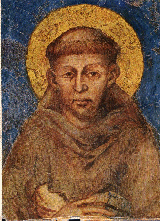
Francis of Assisi is undisputedly one of the greatest saints of the Catholic Church and one of the most important figures of the Middle Ages. His unusual life and his many-layered message can of course only be traced here in broad outline. But perhaps it can be made clear that the spirituality of the “little poor man” of Assisi has a significance reaching far beyond his own time, and speaks to many of our present-day problems in particular.
1182 Francis, whose real name is Francesco Bernardone, is born the son of a rich cloth merchant in the town of Assisi in central Italy. His life is one of wealth and plenty; he is the ringleader at the extravagant parties of the well-to-do young people of the town.
1202 Driven by the desire to win fame and honour, he takes part in a campaign against the neighbouring town of Perugia. He is taken prisoner and spends a year in a dungeon before being released for a ransom.
1205 Once more he tries his luck as a knight and joins a campaign to southern Italy organised by a nobleman. During the campaign he has a dream in which God speaks to him: “Which lord do you want to serve, a lesser one or the greatest?” He abandons the campaign and decides to place his life in the service of God. On a road he meets a leper. At first he intends to give him some money and ride on. But then he gets down from his horse and embraces the leper. For the time, this was an unprecedented breaking of a taboo, and it shook Francis deeply. He realised that God meets us in the form of the poor and the outcast, and that this was also why Jesus lived in poverty and was persecuted. Even at the end of his life, in his Testament, he calls this encounter the decisive turning point. A conflict breaks out with his father, who cannot accept his son’s new life and takes him to court. In a dramatic scene in the market square of Assisi, Francis strips himself naked, hands his clothes to his father and places himself under the protection of the bishop. He says: “From today I will no longer say ‘Father Pietro Bernardone’ but ‘Father in heaven’.”
1206 Not yet knowing how to shape his religious life, Francis spends a great deal of time in the countryside around Assisi and in churches. In the ruined church of San Damiano he has a vision. Christ speaks to him from the cross: “Rebuild my church, which is falling into ruin.” Francis takes the task literally, begs for stones and building materials and restores the church. In time he comes to see that the task was also meant in a figurative sense, as a call to reform the whole Church, which is suffering from divisions and the abuse of power.
1208 After being laughed at by the people of Assisi for years, he is now joined by his first companions. Often they are rich and educated people who give everything away in order to live freely before God, for and with the poor. They begin a simple ministry of preaching and give themselves a Rule made up of quotations from the Gospels. The Rule lays down that (unlike the existing orders) they may own no property whatsoever, that they are to live by simple day labour and, if need be, by begging, and that their place is to be at the side of ordinary people held in low esteem. They are to proclaim God’s word of peace and redemption above all by their example, but also by preaching.
1210 The group is repeatedly suspected of being heretical and of preaching doctrines outside the Church’s teaching – an accusation that could cost one’s life in the Middle Ages. So Francis goes to Rome with his companions, where the cardinals and the Pope are greatly impressed by their way of life and their radicalism. Pope Innocent III, probably the most powerful man of the Middle Ages and a resolute champion of a Church that insisted on political and economic power, approves the Rule of the Franciscans, which is based on owning nothing and on the evangelical power of humility and non-violence.
1212 The young noblewoman Clare of Assisi joins the order. Francis and his friends hide her from her relatives, who want to bring her back. Clare becomes the founder of the women’s branch of the Franciscan Order, the so-called Poor Clares. She is the first woman in the history of the Church to write a religious rule of her own. Unlike the more active Francis, she puts the emphasis on contemplation and mysticism.
1218 The Franciscan Order, whose official name is “Ordo Fratrum Minorum” (Order of Lesser Brothers), has grown enormously and become a mass movement that has spread all over Europe. The cardinals press Francis, for practical reasons, to give up absolute poverty and to write a new Rule. Francis resists this before the Pope, but agrees to draw up a new Rule.
1219 Francis travels to Palestine to see the places where Jesus lived and worked. He sees the cruelties of the crusaders and, in a sermon, calls on them to end the war – and is roundly laughed at. Unarmed, he goes over to the Arab army, which, contrary to his expectations, does not kill him, and has himself taken to the Sultan. The Sultan turns out to be a cultivated and educated ruler, who talks with Francis about questions of faith and gives him an offer of peace to take back to the crusaders, which they, however, do not take seriously. (This visit is well documented historically. Besides the Franciscan sources there is also the account of a participant in the crusade, and even a contemporary Arab account which describes, so to speak, the other side of the event.)
1221 After Francis returns, conflicts break out in the order. Many brothers want the obligation of poverty relaxed and the emphasis shifted away from service to the poor towards theology and preaching. Although Francis is deeply disappointed at the watering-down of his ideals, he refrains from an open power struggle, which he could have won with his authority as founder of the order. He resigns as Minister General (= head of the order) and trusts in the power of the Holy Spirit. But he reserves for himself the task of rewriting the Rule.
1223 The new Rule written by Francis is adopted by the General Chapter (the assembly of all the brothers) and approved by the Pope. It reaffirms the obligation of poverty, but it also takes account of the practical needs of a large community and is therefore, at heart, a compromise.
1224 Francis often withdraws for long periods of prayer, and on Mount La Verna he has a vision of the crucified Christ, after which the stigmata can be seen on his body. He tries to hide them so as not to have to make his mystical experiences public.
1225 Francis is seriously ill: for years he has suffered from malaria and from an eye disease he brought back from Palestine, which now leads to complete blindness. In deep depression he writes the “Canticle of the Sun”, in which he affirms once more his close bond with the whole of creation, living and non-living. He addresses the sun, the moon, the four elements and even bodily death as brothers and sisters, and gives voice to an attitude of thanksgiving and trust towards God the Creator.
1226 Francis dies surrounded by many of his brothers, whom he blesses one last time. In his Testament he once more stresses two of his most important concerns: love of Christ through a poor and humble life in communion with the poor, and love of Christ through loyalty to the Church he founded.
1228 Francis is canonised by the Pope. The order, which by this time already numbers more than six thousand brothers, continues to spread and today exists all over the world. The influence of Franciscan spirituality reaches far beyond the boundaries of the order, and even beyond those of Christianity.