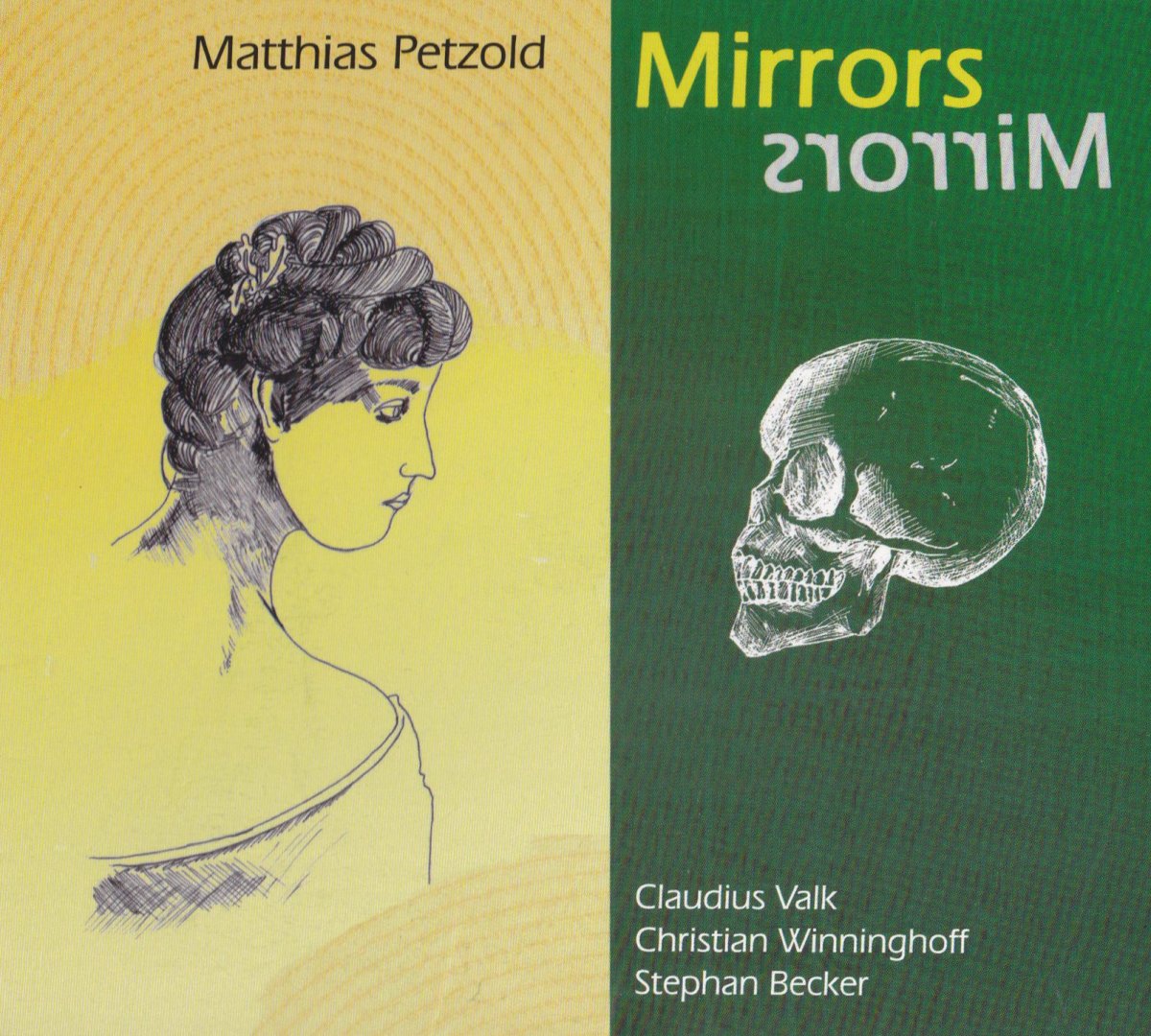
Suite for orchestra and jazz combo
- Label
- Indigo Records 1009 CD, 2012
- All compositions
- Matthias Petzold, except “Star-Crossed Lovers”: Duke Ellington/Billy Strayhorn
- Recorded
- on 29 September 2012 by Andi Reisner
- Mixed and mastered
- by Andi Reisner, Pulsarstudio
- Cover design
- Keanu Barton Sapadi
- Photos
- Kilian Petzold
15,– € incl. VAT, postage and packing
About the music
“With “Mirrors”, the Brühl saxophonist and jazz composer Matthias Petzold presented his third project for large forces on 28 September 2012, after the “Psalmen und Lobgesänge” for choir and jazz ensemble and “Pangäa” for big band. “Mirrors” is a suite for symphony orchestra and jazz combo with three soloists on trumpet, tenor and baritone saxophone. The compositions draw on motifs from William Shakespeare’s plays and poems and, from there, develop a labyrinth of movements, reflections and tonal colours, of violent and tender moods.
Tracks
- When Shall We Three Meet Again? (Violence And Love) 13:20
- Mirrors 10:09
- Oberon (Waldsommernachtsleuchten) 8:50
- Ophelia´s Dream 13:02
- Star-Crossed Lovers (Duke Ellington/Billy Strayhorn) 7:09
- Sonnet To The Dark Lady (for saxophone quartet) 8:50
To listen to: When Shall We Three Meet Again?, Mirrors, Oberon and Ophelia´s Dream
Line-up
- Matthias Petzold composition, director
Jazz combo
- Christian Winninghoff trumpet
- Claudius Valk tenor and soprano saxophone
- David Stahl baritone saxophone
- Stephan Becker piano
- Stefan Rey bass
- Thomas Esch drums
Orchestra
- Marion Schmitz flute
- Friederike Sasse flute
- Michael Taglinger oboe
- Laura Totenhagen oboe
- Konstantin Werner clarinet
- Florian Tambour clarinet
- Joachim Graf bassoon
- Helena Haase bassoon
- Doreen Schulte-Lusch alto saxophone
- Magdalena Sasse tenor saxophone
- Zuzana Leharova violin 1
- Christine Jakobs violin 1
- Anna Kurbanow violin 1
- Roman Estl violin 1
- Mechthild Pfingstmann violin 1
- Angelika Grunenberg violin 2
- Elena Sonntag violin 2
- Susanne Skiba violin 2
- Lara Bäuml violin 2
- Yvonne Bastian viola
- Bettina Sattler viola
- Monika Estl viola
- Uta Führer viola
- Ulrike Zavelberg cello
- Martin Fischer cello
- Jochen Schmitz cello
- Thomas Heyn double bass
Saxophone quartet
- Andreas Hilner soprano saxophone
- Elmar Frey alto saxophone
- Matthias Petzold tenor saxophone
- Frank Riedel baritone saxophone
Mirrors
A few notes on the compositions
This text comes from the programme booklet for the premiere of the suite on 28 September 2012
Through the titles of its individual pieces and the dramatic shape of the music, the suite “Mirrors” has a literary subtext: all the pieces but one refer to characters or plays by William Shakespeare.
One might ask whether such an approach makes sense at all, whether it does not rob the music of its independence – and, to put it more sharply, whether the composer is not making a cheap attempt to enhance his music by sticking a famous name on it.
First of all: of course you can listen to the “Mirrors” suite as pure music too. Since I have not written programme music – the link to Shakespeare does not lie in a musical depiction of the plays – you do not necessarily need to know the literary connections. So anyone could put this text down at this point with a clear conscience and concentrate on the music.
All the same, knowing how I as a composer responded to my sources opens up a further dimension of the compositions that is interesting for the listener too. This additional dimension had a decisive influence on the process of composition. What follows is therefore an invitation to get to know this side of the pieces.
Oberon
Oberon is the first piece of the suite that I composed, even though it now comes third in the order of the suite. When I wrote it, I had no intention whatsoever of writing a longer work. I wanted to try out writing for orchestra and, in the summer holidays of 2003, when we could not go away because we were moving house, to do something I enjoyed alongside the renovating. The title only came during the composing: the exceptionally hot summer, with a lot of time spent by the lake and in the woods (with glow-worms!), reminded me of the atmosphere of Shakespeare’s “A Midsummer Night’s Dream”, and above all of the figure of Oberon, king of the fairies, who thus gave the piece its title.
When Shall We Three Meet Again? (Violence And Love)
Only after a provisional performance of “Oberon” by the Collegium Musicum of the Brühl music school had shown that my way of writing for orchestra worked at all did I decide to expand the project and pursue it further. It was in this context that the idea came up of taking the link to Shakespeare as a common thread. Years before, I had seen “Macbeth” in the theatre and had been struck by the relentlessness of its violence and the dark mood of the play. At the beginning of 2005 this seemed to me a suitable vehicle for reflecting the news of war and violence from all over the world.
I wrote the opening sequence (now the beginning of the concert) as a reflection of aggression and violence, in a way I had never composed before. Afterwards I realised that I could not, and did not want to, go on composing like that. For me the violence of the opening called for a counterweight, which was then provided by the slow blues that breaks in abruptly. As the piece goes on, the two levels stand side by side and become more and more connected through their motifs – something I had not planned at all, but which came about by itself in the course of the work.
So the piece as a whole is not to be heard as a portrayal of the tragedy of “Macbeth”, but as a compositional response to the themes the play raises. The quintessence might be that aggression and gentleness are two sides of the same coin. If the aggression can be meaningfully bound into the whole, its positive quality remains: energy.
Mirrors
The piece “Mirrors”, which was composed next and comes second in the concert order, is the only one not based on a literary motif. For me the mirror was an emblem of Shakespeare’s world, in which things are often other than they seem and in which people wander about in a fleeting world full of deceptions. The way it is composed – with fugal entries, polyphonic voice-leading, mirrored motifs and dynamic contrasts – takes up devices from the music of the 16th and 17th centuries, though without imitating its sound.
Ophelia´s Dream
“Ophelia´s Dream” is the second pillar of the whole suite, the second engagement with destructive processes. In “Hamlet”, Ophelia is Hamlet’s beloved. He loves her sincerely and wants to marry her. But because he is too weak and too cowardly to confront his stepfather, who murdered his father, openly, Hamlet stages an intrigue. As part of that intrigue he also rejects Ophelia. Although from his point of view he only does so for appearance’s sake, she is broken by it, goes mad and finally takes her own life.
The composition works with sharp sounds, chromatically shifted chords and fraying structures. At the culmination of the destruction the mood tips over: behind the dark wall, things go on after all. The theme of the opening is reinterpreted in harmony and sound. It loses its ambivalence and heaviness and sounds light and bright. So here too it is not merely a matter of depicting destruction, but of a way of coming to terms with it through creativity.
Star-Crossed Lovers
The last movement of the suite is a composition by Duke Ellington, arranged and expanded by me, which he wrote as a commission for a Shakespeare festival in Canada. The play that gives it its title is of course “Romeo and Juliet”. In his unshakeable kindliness (which led the bassist Charles Mingus to call one of his compositions “Duke Ellington´s Sound of Love”), Ellington blanks out the tragic and violent side of the play completely. “Star-Crossed Lovers” is a calm, sonorous, flowing hymn to a love that overcomes everything. As such, the piece is both my bow to one of the greatest composers of the 20th century and the most fitting close imaginable for the whole suite.
Sonnet To The Dark Lady
Although it was written for a completely different line-up, the piece “Sonnet To The Dark Lady” belongs to the same group of compositions as the orchestral pieces. While Shakespeare’s dramatic works found their way into pieces for symphony orchestra and jazz combo, the smaller line-up of a saxophone quartet seemed right for the more fleeting sonnets.
In the 154 sonnets that Shakespeare wrote within four years to an unknown beloved (the “Dark Lady”) and to a friend, every facet of love is reflected in unbridled, sometimes seemingly exaggerated emotions: happiness, despair, jealousy, longing, self-loathing, admiration, distance. I have tried to translate this into music with three themes: one calm and self-assured, one cheerful and lively, and one subdued and melancholy. These three are introduced, mingle, break off, flare up again and finally disappear.
Matthias Petzold, September 2012
Press
[…] The very taut and complex compositions, which work through an almost extravagant wealth of ideas, drive the music forward at a positively breathtaking pace; only the combo improvisations, which act as a kind of reflective layer on the compositions, give the listener a chance to pause and take in what has gone before. […]
At the end of what is probably Petzold’s most demanding and most unwieldy work, a real treat rewards the listener’s concentration: a movement for saxophone quartet that works with a Shakespeare sonnet, with Petzold himself among the players. With its intimacy and lyrical introspection it forms an almost beguiling counterpart to the expressive fury of the orchestral suite.
Jazzpodium 5/13
Mirror images of Shakespeare characters – premiere of the suite Mirrors
[…] A primal force broke through, unshielded … At first the crushing weight of an aggressive tangle of voices left no room for sensitivity. The power struggle tugged the violins back and forth between sighs and thunder; for a moment the piano (Stephan Becker) tries to bring things to their senses, but fails against the dominant model of ‘Macbeth’. In the end a blues finally manages to resolve the struggle […] Matthias Petzold gave the soloists of the jazz combo the time and space to stretch out in their solos. The whole orchestra was convincing in its focused ensemble playing, its nuanced changes of tempo and volume and its good sense of timing. ‘Mirrors’ can certainly claim to have found a viable path in the category of “symphonic jazz”.
Jazzpodium 11/2012 on the premiere